Fantasia
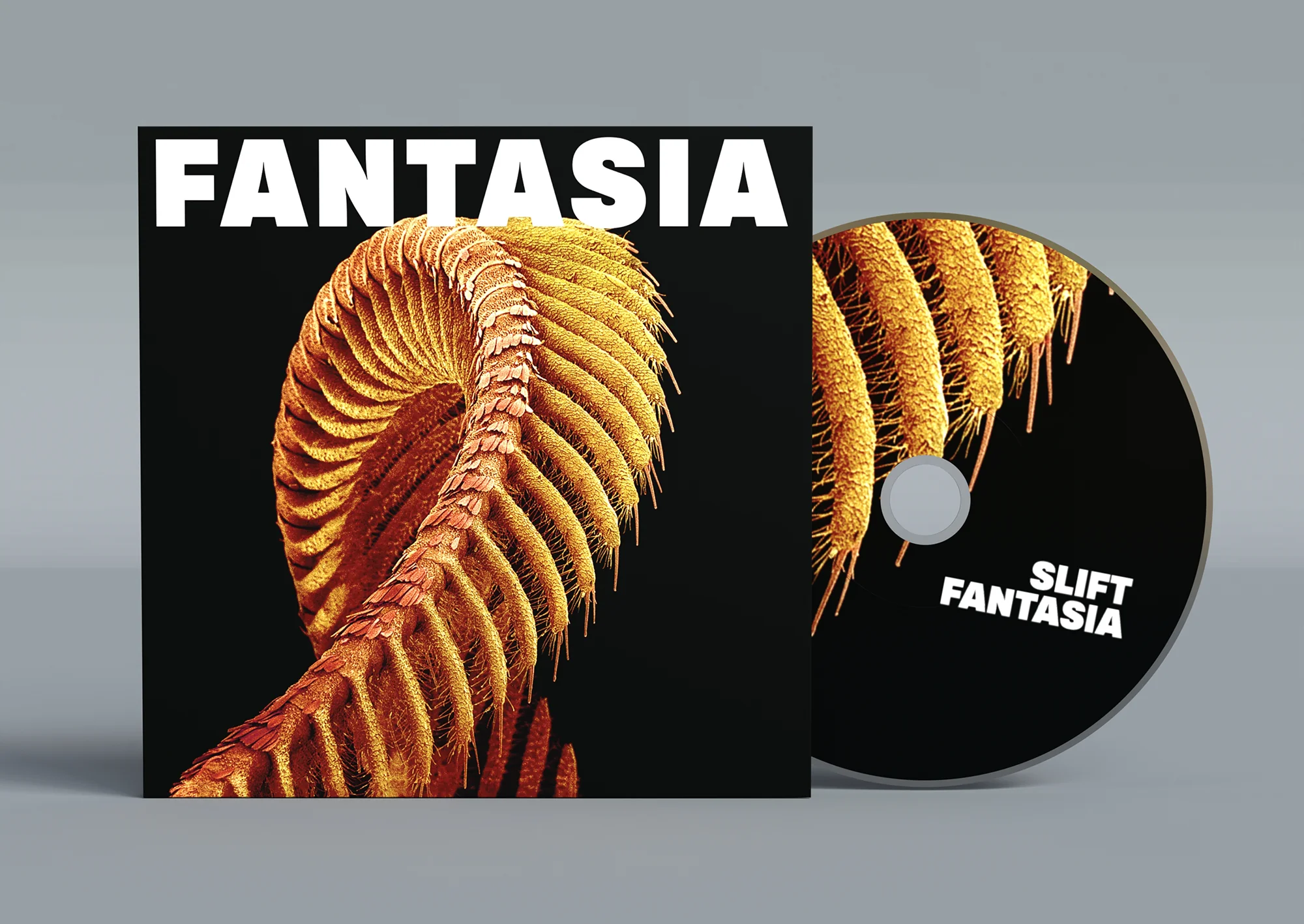
In the technical sense, every previous album by the radiant and heavy French trio SLIFT has been a fantasia—a composite of genres and forms that allowed the band to improvise, to jam on themes until they seemed to spiral together into space. Their acclaimed third album, 2024’s Ilion, was a sci-fi story built with 10- to 13-minute exploratory escapades, often starting with doom metal or stoner rock before spinning freely into glorious instrumental oblivion. But, in a bit of intentional irony, SLIFT’s fourth album is actually called Fantasia. It’s their leanest and most direct record to date; taken together, its eight songs clock in at less than 50 minutes. It is also their most riveting album yet, a pointed saga about overcoming international upheaval delivered by a band bearing down, not wasting a single second in the process.
They wanted to write and render songs that recognized the turmoil of these days and to sing of a more hopeful vision, of a time when a reckoning arrives. SLIFT didn’t want to lose the message by playing too much. To wit, the longest song on Fantasia is the opening title track, a nine-minute preamble in which Jean Fossat screams of his desires for the world: rising above our pain, burying our dread, and finding, individually and collectively, “a fire for your soul.” The songs that follow aren’t lacking the complexity or intensity that have made SLIFT a rising, radical star in heavy music; it’s simply that they’ve found new ways to weave the complexities of their past inside every piece, like a tapestry that reveals a new layer every time you look. In doing so, they offer an affirming and urgent message: Together, we can still change the times in which we live.
Though only Jean and bassist Rémi Fossat are related, SLIFT is essentially a band of brothers. They’ve been friends with drummer Canek Flores since high school, and 2026 marks a decade together in this trio. They rehearse with religious regularity in a basement in the countryside near Toulouse, inside the jam room where they’ve long indulged their propensity for longform wonder. But they built the songs of Fantasia differently. Jean started many of the songs by himself, then quickly brought them to basement rehearsals with a clear and concise idea of how he imagined them taking shape. At first, SLIFT struggled to keep the songs tight, old habits making them wonder if this song or that one shouldn’t break the double-digit threshold. By the time they crossed France’s northern border into Belgium to record in the enormous live room at Daft Studios, though, the songs were lean, agile, and punchy. They made most of them in a single take.
As Jean Fossat wrote the core of Fantasia, he thought a lot about Jorge Luis Borges, the Argentinian author whose fiction deftly wove elements of magic and surreality into places and plots that almost felt real. He wanted to accomplish the same thing, to add supernatural touches to his contemplations of politics so that the listener might see reality differently, might question what they were missing about this plane. SLIFT even borrowed the song title “Orbis Tertius” from a 1940 Borges short story that uses the idea of subjective idealism—that is, believing the world only exists as far as our minds go—to ask questions of memory, history, possibility, and, ultimately, control. Fantasia, then, is an imagined town plagued by a sense of unknowing and xenophobia, of trying to eliminate anything that disrupts the accepted order.
The town first comes into focus on “Corrupted Sky,” where lurid keyboards and a relentless rhythm section illustrate a city of power-hungry wastrels. Jean’s guitar solo feels like an exhilarating chase sequence in a video game, as he tries to dodge doom while arriving in Fantasia. They treat the newcomer like poison incarnate during the prog gem “The Village,” while he predicts their downfall during “A Storm of Wings.” In a mighty, fists-up anthem that suggests Clutch getting wild, SLIFT alludes to John Coltrane, Charlie Parker, and Soviet writer Mikhail Bulgakov to portend the arrival of some great liberating force, some redemptive truth.
That slowly starts to emerge during the record’s back half, as memory returns to the masses, as people start to remember that they are more than the oppressive uniformity of their society. “Waiting Man”—a psychedelic ballad that suggests Pink Floyd wandering into the Master of Reality sessions—is the breaking point. The narrator realizes that the world he’s committed to is a lie. “I waited for love, waited my time,” Jean Fossat sings, his voice more vulnerable than it’s ever been. “Waited the seasons of my life.” He knows he must find his own way out of this mess and into something better, so long as it’s not too late.
It is dreadfully easy these days to feel powerless. We have instant access to a world of news, and so much of it is so very heavy. SLIFT reckons directly with the modern onslaught of cruelty and absurdity on Fantasia, whether that’s not caring about our home planet or one another. But these eight songs are about trusting in some hidden power for fighting back, for believing in a world where something we cannot yet articulate or define offers not just a way to disrupt the status quo but perhaps to destroy it completely. SLIFT is loud, heavy, and aggressive inside these anthems. They’re preparing for a battle they think we can still win.
Original: $10.00
-65%$10.00
$3.50

Description
In the technical sense, every previous album by the radiant and heavy French trio SLIFT has been a fantasia—a composite of genres and forms that allowed the band to improvise, to jam on themes until they seemed to spiral together into space. Their acclaimed third album, 2024’s Ilion, was a sci-fi story built with 10- to 13-minute exploratory escapades, often starting with doom metal or stoner rock before spinning freely into glorious instrumental oblivion. But, in a bit of intentional irony, SLIFT’s fourth album is actually called Fantasia. It’s their leanest and most direct record to date; taken together, its eight songs clock in at less than 50 minutes. It is also their most riveting album yet, a pointed saga about overcoming international upheaval delivered by a band bearing down, not wasting a single second in the process.
They wanted to write and render songs that recognized the turmoil of these days and to sing of a more hopeful vision, of a time when a reckoning arrives. SLIFT didn’t want to lose the message by playing too much. To wit, the longest song on Fantasia is the opening title track, a nine-minute preamble in which Jean Fossat screams of his desires for the world: rising above our pain, burying our dread, and finding, individually and collectively, “a fire for your soul.” The songs that follow aren’t lacking the complexity or intensity that have made SLIFT a rising, radical star in heavy music; it’s simply that they’ve found new ways to weave the complexities of their past inside every piece, like a tapestry that reveals a new layer every time you look. In doing so, they offer an affirming and urgent message: Together, we can still change the times in which we live.
Though only Jean and bassist Rémi Fossat are related, SLIFT is essentially a band of brothers. They’ve been friends with drummer Canek Flores since high school, and 2026 marks a decade together in this trio. They rehearse with religious regularity in a basement in the countryside near Toulouse, inside the jam room where they’ve long indulged their propensity for longform wonder. But they built the songs of Fantasia differently. Jean started many of the songs by himself, then quickly brought them to basement rehearsals with a clear and concise idea of how he imagined them taking shape. At first, SLIFT struggled to keep the songs tight, old habits making them wonder if this song or that one shouldn’t break the double-digit threshold. By the time they crossed France’s northern border into Belgium to record in the enormous live room at Daft Studios, though, the songs were lean, agile, and punchy. They made most of them in a single take.
As Jean Fossat wrote the core of Fantasia, he thought a lot about Jorge Luis Borges, the Argentinian author whose fiction deftly wove elements of magic and surreality into places and plots that almost felt real. He wanted to accomplish the same thing, to add supernatural touches to his contemplations of politics so that the listener might see reality differently, might question what they were missing about this plane. SLIFT even borrowed the song title “Orbis Tertius” from a 1940 Borges short story that uses the idea of subjective idealism—that is, believing the world only exists as far as our minds go—to ask questions of memory, history, possibility, and, ultimately, control. Fantasia, then, is an imagined town plagued by a sense of unknowing and xenophobia, of trying to eliminate anything that disrupts the accepted order.
The town first comes into focus on “Corrupted Sky,” where lurid keyboards and a relentless rhythm section illustrate a city of power-hungry wastrels. Jean’s guitar solo feels like an exhilarating chase sequence in a video game, as he tries to dodge doom while arriving in Fantasia. They treat the newcomer like poison incarnate during the prog gem “The Village,” while he predicts their downfall during “A Storm of Wings.” In a mighty, fists-up anthem that suggests Clutch getting wild, SLIFT alludes to John Coltrane, Charlie Parker, and Soviet writer Mikhail Bulgakov to portend the arrival of some great liberating force, some redemptive truth.
That slowly starts to emerge during the record’s back half, as memory returns to the masses, as people start to remember that they are more than the oppressive uniformity of their society. “Waiting Man”—a psychedelic ballad that suggests Pink Floyd wandering into the Master of Reality sessions—is the breaking point. The narrator realizes that the world he’s committed to is a lie. “I waited for love, waited my time,” Jean Fossat sings, his voice more vulnerable than it’s ever been. “Waited the seasons of my life.” He knows he must find his own way out of this mess and into something better, so long as it’s not too late.
It is dreadfully easy these days to feel powerless. We have instant access to a world of news, and so much of it is so very heavy. SLIFT reckons directly with the modern onslaught of cruelty and absurdity on Fantasia, whether that’s not caring about our home planet or one another. But these eight songs are about trusting in some hidden power for fighting back, for believing in a world where something we cannot yet articulate or define offers not just a way to disrupt the status quo but perhaps to destroy it completely. SLIFT is loud, heavy, and aggressive inside these anthems. They’re preparing for a battle they think we can still win.