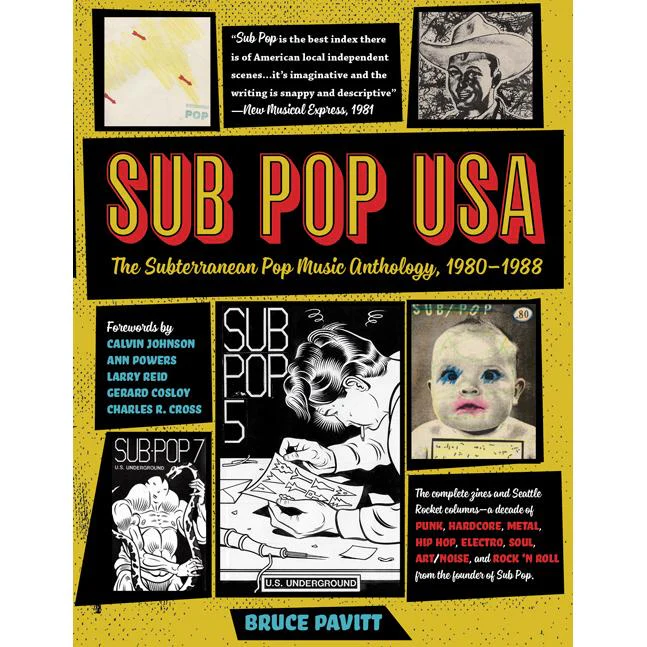
Sub Pop USA: The Subterranean Pop Music Anthology, 1980-1988
“For over thirty years, Bruce Pavitt has been at the vanguard of popular culture, artistic trends, and ideas within the communities of the innovative alternative. The insight into this period of rock history could only have been delivered by Bruce, given the unique nature of his experience, vision, and voice.”—Kim Thayil, Soundgarden
“Sub Pop is the best index there is of American local independent scenes…imaginative and the writing is snappy and descriptive”—New Musical Express (NME), 1981
“We need diverse, regionalized, localized approaches to all forms of art, music, and politics…the most intense music, the most original ideas are coming out of scenes you don’t even know exist. Tomorrow’s pop is being realized today on small decentralized record labels that are interested in taking risks, not making money.”—Sub Pop #1, 1980
“For over thirty years, Bruce Pavitt has been at the vanguard of popular culture, artistic trends, and ideas within the communities of the innovative alternative. The insight into this period of rock history could only have been delivered by Bruce, given the unique nature of his experience, vision, and voice.”—Kim Thayil, Soundgarden
“Sub Pop is the best index there is of American local independent scenes…imaginative and the writing is snappy and descriptive”—New Musical Express (NME), 1981
“We need diverse, regionalized, localized approaches to all forms of art, music, and politics…the most intense music, the most original ideas are coming out of scenes you don’t even know exist. Tomorrow’s pop is being realized today on small decentralized record labels that are interested in taking risks, not making money.”—Sub Pop #1, 1980
Over 1,000 recording artists hunted down and hyped in their original indie habitats, including Black Flag, Sonic Youth, Hüsker Dü, the Wipers, Dinosaur Jr., Run-D.M.C., Slayer, Beastie Boys, Mudhoney…plus an entire nation of inspired amateurs.
In 1979, Bruce Pavitt moved from Chicago to Olympia, Washington, and began programming a show called Subterranean Pop on local community radio station KAOS-FM. In 1980, he launchedSubterranean Pop magazine, dedicated to the unsung punk, new wave, and experimental regional bands of the Pacific Northwest and Midwest. Calvin Johnson of K Records joined the zine’s staff later that year, beginning with the second issue.
The Sub Pop zine puzzled punk and new wave fans from major cities; readers were surprised that there were enough bands in the forgotten cities and states to devote a column, let alone an entire fanzine. Even more puzzling was the exclusion of artists like the Clash, Gang of Four, Blondie, or PIL, solely because of their major label associations. Driven by the power of independent thinking, early issues featured impassioned rallying cries for local action that make more sense than ever today, alongside early published artwork by Linda Barry, Charles Burns, and Jad Fair.
In 1983, Pavitt moved to Seattle and commenced his widely-read Sub Pop USA column in the Rocket newspaper, each month exposing new underground and independent artists. From Beat Happening and Pell Mell to early records by the Beastie Boys, Metallica, and Run-D.M.C., Sub Pop was a 1980s independent music bible, written with a diverse appreciation for happening scenes across the USA. In 1986, Pavitt put his ideas into practice, launching Sub Pop Records with the historic Sub Pop 100compilation and Soundgarden’s first release, Screaming Life. While the Sub Pop Records legacy is today legendary, the groundwork and creative wellspring that put Seattle on the musical map is assembled here for the first time.
Description
“For over thirty years, Bruce Pavitt has been at the vanguard of popular culture, artistic trends, and ideas within the communities of the innovative alternative. The insight into this period of rock history could only have been delivered by Bruce, given the unique nature of his experience, vision, and voice.”—Kim Thayil, Soundgarden
“Sub Pop is the best index there is of American local independent scenes…imaginative and the writing is snappy and descriptive”—New Musical Express (NME), 1981
“We need diverse, regionalized, localized approaches to all forms of art, music, and politics…the most intense music, the most original ideas are coming out of scenes you don’t even know exist. Tomorrow’s pop is being realized today on small decentralized record labels that are interested in taking risks, not making money.”—Sub Pop #1, 1980
“For over thirty years, Bruce Pavitt has been at the vanguard of popular culture, artistic trends, and ideas within the communities of the innovative alternative. The insight into this period of rock history could only have been delivered by Bruce, given the unique nature of his experience, vision, and voice.”—Kim Thayil, Soundgarden
“Sub Pop is the best index there is of American local independent scenes…imaginative and the writing is snappy and descriptive”—New Musical Express (NME), 1981
“We need diverse, regionalized, localized approaches to all forms of art, music, and politics…the most intense music, the most original ideas are coming out of scenes you don’t even know exist. Tomorrow’s pop is being realized today on small decentralized record labels that are interested in taking risks, not making money.”—Sub Pop #1, 1980
Over 1,000 recording artists hunted down and hyped in their original indie habitats, including Black Flag, Sonic Youth, Hüsker Dü, the Wipers, Dinosaur Jr., Run-D.M.C., Slayer, Beastie Boys, Mudhoney…plus an entire nation of inspired amateurs.
In 1979, Bruce Pavitt moved from Chicago to Olympia, Washington, and began programming a show called Subterranean Pop on local community radio station KAOS-FM. In 1980, he launchedSubterranean Pop magazine, dedicated to the unsung punk, new wave, and experimental regional bands of the Pacific Northwest and Midwest. Calvin Johnson of K Records joined the zine’s staff later that year, beginning with the second issue.
The Sub Pop zine puzzled punk and new wave fans from major cities; readers were surprised that there were enough bands in the forgotten cities and states to devote a column, let alone an entire fanzine. Even more puzzling was the exclusion of artists like the Clash, Gang of Four, Blondie, or PIL, solely because of their major label associations. Driven by the power of independent thinking, early issues featured impassioned rallying cries for local action that make more sense than ever today, alongside early published artwork by Linda Barry, Charles Burns, and Jad Fair.
In 1983, Pavitt moved to Seattle and commenced his widely-read Sub Pop USA column in the Rocket newspaper, each month exposing new underground and independent artists. From Beat Happening and Pell Mell to early records by the Beastie Boys, Metallica, and Run-D.M.C., Sub Pop was a 1980s independent music bible, written with a diverse appreciation for happening scenes across the USA. In 1986, Pavitt put his ideas into practice, launching Sub Pop Records with the historic Sub Pop 100compilation and Soundgarden’s first release, Screaming Life. While the Sub Pop Records legacy is today legendary, the groundwork and creative wellspring that put Seattle on the musical map is assembled here for the first time.